Seismic Network Operations
IU NWAO
Narrogin, Australia
IU NWAO commences operations on: 1991,329
| Host: | Geoscience Australia |
|---|---|
| Latitude: | -32.928 |
| Longitude: | 117.239 |
| Elevation: | 380 |
| Datalogger: | Q330 |
| Broadband: | KS-54000 |
| Accelerometer: | FBA_ES-T_EpiSensor_Accelerometer |
| Telemetry Status at the NEIC: |
|
Vault Condition: Borehole
Site Geology: Seismometer is located on the Pre-Cambrian shield known as Yilgarn block which consists of granite and granite gneiss. The age of the granite is about 2500m years. The site is in the south-west corner of the block, 230 km from the southern boundary and coast, and 130 km from the western boundary which is the Darling Fault. Site is 150 km from the west coast.
| Location Code | Channel Code | Instrument | Flags | Sample Rate | Dip | Azimuth | Depth |
|---|---|---|---|---|---|---|---|
| 30 | LDO | CI/PAS pressure sensor | CW | 1.00 | 0.00 | 0.00 | 0.00 |
| 20 | LN2 | FBA ES-T EpiSensor Accelerometer | CG | 1.00 | 0.00 | 90.00 | 0.00 |
| 20 | LN1 | FBA ES-T EpiSensor Accelerometer | CG | 1.00 | 0.00 | 0.00 | 0.00 |
| 20 | HN2 | FBA ES-T EpiSensor Accelerometer | TG | 100.00 | 0.00 | 90.00 | 0.00 |
| 20 | HN1 | FBA ES-T EpiSensor Accelerometer | TG | 100.00 | 0.00 | 0.00 | 0.00 |
| 10 | VH2 | STS-2 Standard-gain | CG | 0.10 | 0.00 | 90.00 | 0.00 |
| 10 | VH1 | STS-2 Standard-gain | CG | 0.10 | 0.00 | 0.00 | 0.00 |
| 10 | HH2 | STS-2 Standard-gain | TG | 100.00 | 0.00 | 90.00 | 0.00 |
| 10 | HH1 | STS-2 Standard-gain | TG | 100.00 | 0.00 | 0.00 | 0.00 |
| 10 | BH2 | STS-2 Standard-gain | CG | 40.00 | 0.00 | 90.00 | 0.00 |
| 10 | BH1 | STS-2 Standard-gain | CG | 40.00 | 0.00 | 0.00 | 0.00 |
| 00 | VH2 | KS-54000 | CG | 0.10 | 0.00 | 169.00 | 105.00 |
| 00 | VH1 | KS-54000 | CG | 0.10 | 0.00 | 79.00 | 105.00 |
| 10 | LH2 | STS-2 Standard-gain | CG | 1.00 | 0.00 | 90.00 | 0.00 |
| 10 | LH1 | STS-2 Standard-gain | CG | 1.00 | 0.00 | 0.00 | 0.00 |
| 00 | LH2 | KS-54000 | CG | 1.00 | 0.00 | 169.00 | 105.00 |
| 00 | LH1 | KS-54000 | CG | 1.00 | 0.00 | 79.00 | 105.00 |
| 00 | BH2 | KS-54000 | CG | 20.00 | 0.00 | 169.00 | 105.00 |
| 00 | BH1 | KS-54000 | CG | 20.00 | 0.00 | 79.00 | 105.00 |
| 20 | LNZ | FBA ES-T EpiSensor Accelerometer | CG | 1.00 | -90.00 | 0.00 | 0.00 |
| 20 | HNZ | FBA ES-T EpiSensor Accelerometer | TG | 100.00 | -90.00 | 0.00 | 0.00 |
| 10 | VHZ | STS-2 Standard-gain | CG | 0.10 | -90.00 | 0.00 | 0.00 |
| 10 | LHZ | STS-2 Standard-gain | CG | 1.00 | -90.00 | 0.00 | 0.00 |
| 10 | HHZ | STS-2 Standard-gain | TG | 100.00 | -90.00 | 0.00 | 0.00 |
| 10 | BHZ | STS-2 Standard-gain | CG | 40.00 | -90.00 | 0.00 | 0.00 |
| 00 | VHZ | KS-54000 | CG | 0.10 | -90.00 | 0.00 | 105.00 |
| 00 | LHZ | KS-54000 | CG | 1.00 | -90.00 | 0.00 | 105.00 |
| 00 | BHZ | KS-54000 | CG | 20.00 | -90.00 | 0.00 | 105.00 |

PDF, Last Month

PDF, Last Year

PDF, Month

PDF, Current Week

PDF, Year


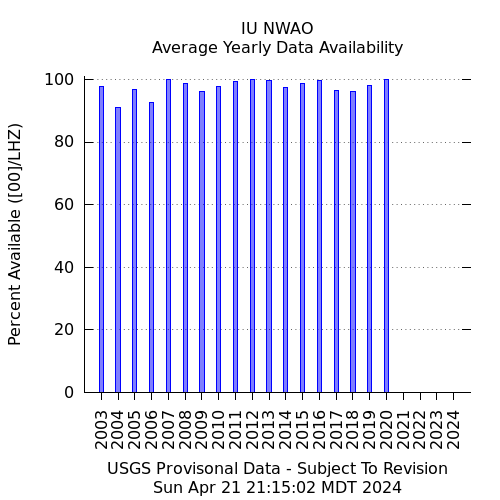
Availability, Since 1972

Availability, 2 Month

As part of the annual calibration process, the USGS runs a sequence that includes a random, a step, and several sine wave calibrations. The USGS analyzes the random binary calibration signal in order to estimate the instrument response. The figures below show the results from the analysis of the most recent processed calibration at the station.
We use an iterative three-step method to estimate instrument response parameters (poles, zeros, sensitivity and gain) and their associated errors using random calibration signals. First, we solve a coarse non-linear inverse problem using a least squares grid search to yield a first approximation to the solution. This approach reduces the likelihood of poorly estimated parameters (a local-minimum solution) caused by noise in the calibration records and enhances algorithm convergence. Second, we iteratively solve a non-linear parameter estimation problem to obtain the least squares best-fit Laplace pole/zero/gain model. Third, by applying the central limit theorem we estimate the errors in this pole/zero model by solving the inverse problem at each frequency in a 2/3rds-octave band centered at each best-fit pole/zero frequency. This procedure yields error estimates of the 99% confidence interval.
| Loc | Chan | Cal Date | Epoch-Span | Grade | Amp Nominal Error (dB) | Amp Best Fit Error (dB) | Phase Nominal Error (degree) | Phase Best Fit Error (degree) | Sensor | Cal Type |
|---|---|---|---|---|---|---|---|---|---|---|
| 00 | BH1 | 2011:121 | 2011:120 to No Ending Ti | A | 0.0095636 | 0.0062758 | 0.053405 | 0.072878 | 54000 | Random |
| 00 | BH2 | 2011:121 | 2011:120 to No Ending Ti | A | 0.010333 | 0.0067528 | 0.056273 | 0.073701 | 54000 | Random |
| 00 | BHZ | 2011:121 | 2011:120 to No Ending Ti | A | 0.019273 | 0.0076181 | 0.051939 | 0.10833 | 54000 | Random |
| 10 | BHZ | 2011:121 | 2011:120 to No Ending Ti | A | 0.012842 | 0.01302 | 0.067463 | 0.073734 | STS-2-SG | Random |
-
Current IssuesHigh noise on the LN1 Episensor component.
-
2011-05-02Upgraded to Q330 digitizer.
-
2010-09-27Maintenance trip. KS54000 fixed.
-
2009-11-06KS54000 is no longer functioning.