Seismic Network Operations
CU SDDR
Presa de Sabenta, Dominican Republic
CU SDDR commences operations on: 2006,242
| Host: | Dept. of Environment and Natural Resources |
|---|---|
| Latitude: | 18.982 |
| Longitude: | -71.288 |
| Elevation: | 589 |
| Datalogger: | Q330 |
| Broadband: | STS-2 |
| Accelerometer: | FBA |
| Telemetry Status at the NEIC: |
|
| Location Code | Channel Code | Instrument | Flags | Sample Rate | Dip | Azimuth | Depth |
|---|---|---|---|---|---|---|---|
| 00 | LHZ | STS-2 | CG | 1.00 | -90.00 | 0.00 | 0.00 |
| 00 | LH2 | STS-2 | CG | 1.00 | 0.00 | 90.00 | 0.00 |
| 00 | LH1 | STS-2 | CG | 1.00 | 0.00 | 0.00 | 0.00 |
| 00 | BHZ | STS-2 | CG | 40.00 | -90.00 | 0.00 | 0.00 |
| 00 | BH2 | STS-2 | CG | 40.00 | 0.00 | 90.00 | 0.00 |
| 00 | BH1 | STS-2 | CG | 40.00 | 0.00 | 0.00 | 0.00 |
| 20 | HN2 | FBA | TG | 100.00 | 0.00 | 90.00 | 0.00 |
| 20 | HN1 | FBA | TG | 100.00 | 0.00 | 0.00 | 0.00 |
| 20 | HNZ | FBA | TG | 100.00 | -90.00 | 0.00 | 0.00 |
| 20 | LN2 | FBA | CG | 1.00 | 0.00 | 90.00 | 0.00 |
| 20 | LN1 | FBA | CG | 1.00 | 0.00 | 0.00 | 0.00 |
| 20 | LNZ | FBA | CG | 1.00 | -90.00 | 0.00 | 0.00 |

00 BH2 Monthly PDF

00 BHZ Monthly PDF

00 LH1 Monthly PDF

00 LH2 Monthly PDF

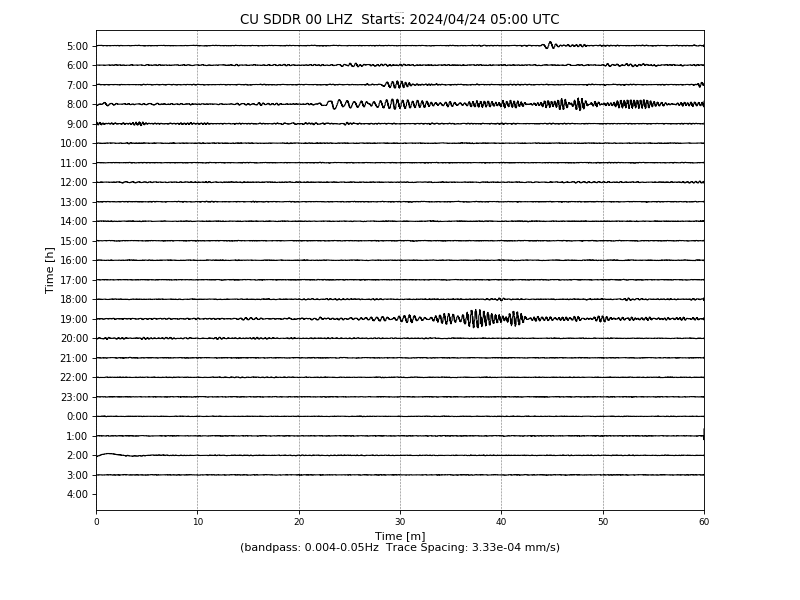
00 LHZ Monthly PDF


Availability, Since 1972

Availability, 2 Month

As part of the annual calibration process, the USGS runs a sequence that includes a random, a step, and several sine wave calibrations. Â The USGS analyzes the random binary calibration signal in order to estimate the instrument response. Â The figures below show the results from the analysis of the most recent processed calibration at the station.
We use an iterative three-step method to estimate instrument response parameters (poles, zeros, sensitivity and gain) and their associated errors using random calibration signals. First, we solve a coarse non-linear inverse problem using a least squares grid search to yield a first approximation to the solution. This approach reduces the likelihood of poorly estimated parameters (a local-minimum solution) caused by noise in the calibration records and enhances algorithm convergence. Second, we iteratively solve a non-linear parameter estimation problem to obtain the least squares best-fit Laplace pole/zero/gain model. Third, by applying the central limit theorem we estimate the errors in this pole/zero model by solving the inverse problem at each frequency in a 2/3rds-octave band centered at each best-fit pole/zero frequency. This procedure yields error estimates of the 99% confidence interval.
| Loc | Chan | Cal Date | Epoch-Span | Grade | Amp Nominal Error (dB) | Amp Best Fit Error (dB) | Phase Nominal Error (degree) | Phase Best Fit Error (degree) | Sensor | Cal Type |
|---|---|---|---|---|---|---|---|---|---|---|
| 00 | BHZ | 2011:108 | 2010:041 to No Ending Ti | A | 0.01385 | 0.014416 | 0.083385 | 0.12663 | STS-2-SG | Random |
-
Current IssuesIntermittent data outages and possible battery problems.